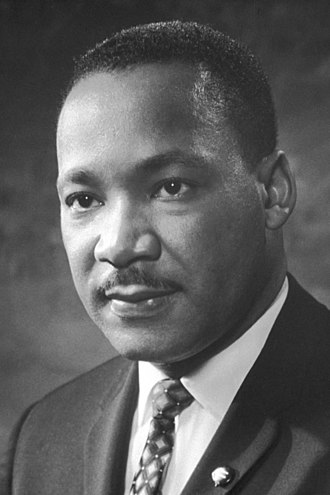
Martin Luther King Jr.
I Have a Dream
I have a dream that my children will be judged not by the color of their skin, but by the content of their character.
The representative leader of the African American civil rights movement and a Baptist minister, he championed the pursuit of racial equality and social justice through nonviolence and civil disobedience. He delivered the "I Have a Dream" speech in 1963, received the Nobel Peace Prize in 1964, and was assassinated in Memphis in 1968.
Biography
Martin Luther King Jr. was born in Atlanta, Georgia, into the family of a Baptist minister. He grew up in the South under legally mandated racial segregation, and as a youth was already fervent about religion and public affairs, following in his forebears' footsteps toward the ministry. The contrast between his family's faith and the reality of the South formed the initial ground of his later devotion to the cause of civil rights.
He studied successively at Morehouse College and Crozer Theological Seminary, and earned a doctorate in theology at Boston University. During his studies he explored the nonviolent ideas of figures such as Mahatma Gandhi, gradually establishing civil disobedience and moral appeal as the core methods of his action. His academic training and religious questioning prepared him intellectually for the public role that lay ahead.
In 1955 he led a bus boycott lasting about a year in Montgomery, Alabama, and thereby grew from a local minister into a national civil rights leader. He then helped found the Southern Christian Leadership Conference, coordinating nonviolent struggles across the South and gathering scattered demands into an organized movement.
In 1963 he delivered the "I Have a Dream" speech at the March on Washington, a landmark moment of the civil rights movement; the following year he was awarded the Nobel Peace Prize. In this period the Civil Rights Act and the Voting Rights Act were enacted one after another, and the movement he led was widely regarded as one of the important driving forces behind them.
In his later years he broadened his focus to issues such as economic inequality and opposition to the Vietnam War, launching the Poor People's Campaign, and thereby bore more controversy and pressure. In 1968, while supporting a strike by sanitation workers in Memphis, Tennessee, he was assassinated at just thirty-nine; when the news broke, many places fell into grief and turmoil.
Martin Luther King Jr. spent his life persistently confronting the difficult questions of race and justice by nonviolent means. However posterity judges him, he is widely seen as one of the most important symbols of the twentieth-century civil rights movement; the United States established a holiday in his honour, and his words on equality and nonviolence continue to influence social movements around the world.
Life Timeline
Growing Up in Atlanta1929–1947
Born into a minister's family, he grew up amid Southern segregation and as a youth resolved to devote himself to religious work.
Study and the Path of Theology1948–1954
He studied successively at Morehouse College and Crozer Theological Seminary, and pursued a doctorate in theology at Boston University.
Debut in Montgomery1954–1959
As minister of a Montgomery church he led the bus boycott, and, influenced by Gandhi's nonviolence, gradually became a nationally known figure.
Organizing and Struggle1960–1962
He founded and led the Southern Christian Leadership Conference (SCLC), driving sit-ins, freedom rides, and other forms of struggle.
Washington and the Nobel1963–1965
The Birmingham campaign, the March on Washington's "I Have a Dream," the Nobel Peace Prize, and the Selma marches.
Against Poverty and War1966–1968
He broadened his issues to economic inequality and opposition to the Vietnam War, launched the Poor People's Campaign, and faced rising controversy and pressure.
Assassination in Memphis1968–1968
He was assassinated while supporting a sanitation workers' strike in Memphis, triggering national mourning and unrest in many places.